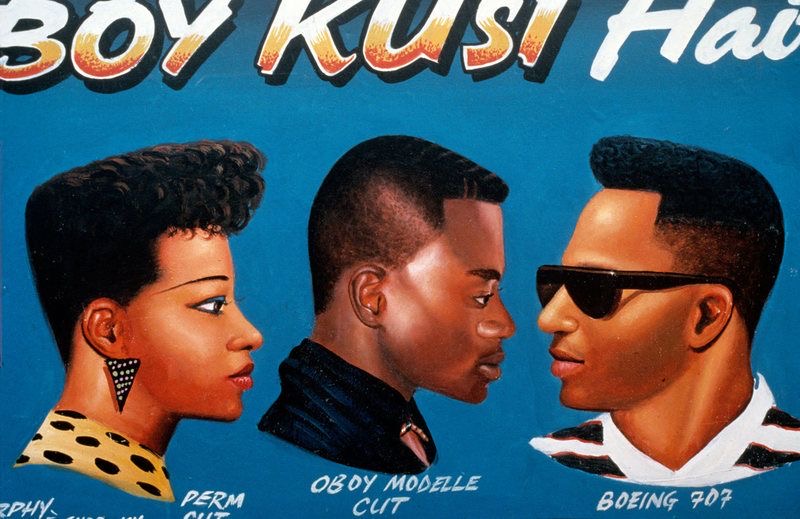
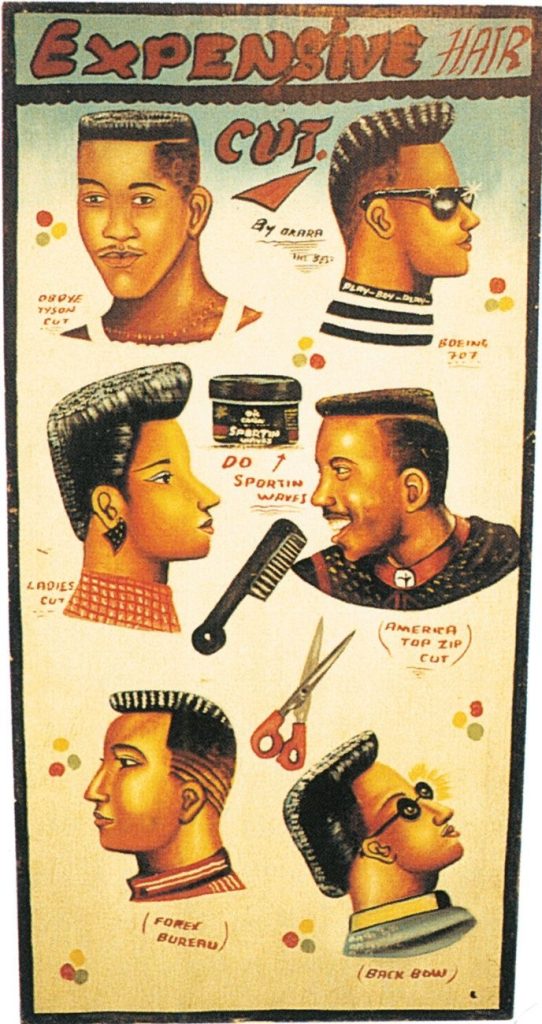
A barbering shop in Accra offers, among its cuts, the Boeing 707. A name for a haircut, not a business. It’s not unique to this one board, either, versions of it turn up on barbershop signs across the city, the country, further than that, alongside Oboye Tyson Cut and Forex Bureau and Back Bow, the same handful of names circulating the way cornrows and knotless braids circulate as words everyone already knows before they ever walk into a specific barbering shop. Nobody invented the Boeing 707 for this one wall. Hair typography is naming twice over, once for the salon or barbershop, and again for the thing being sold inside it, and the second layer draws from a vocabulary that belongs to the whole trade, not to any single sign painter.
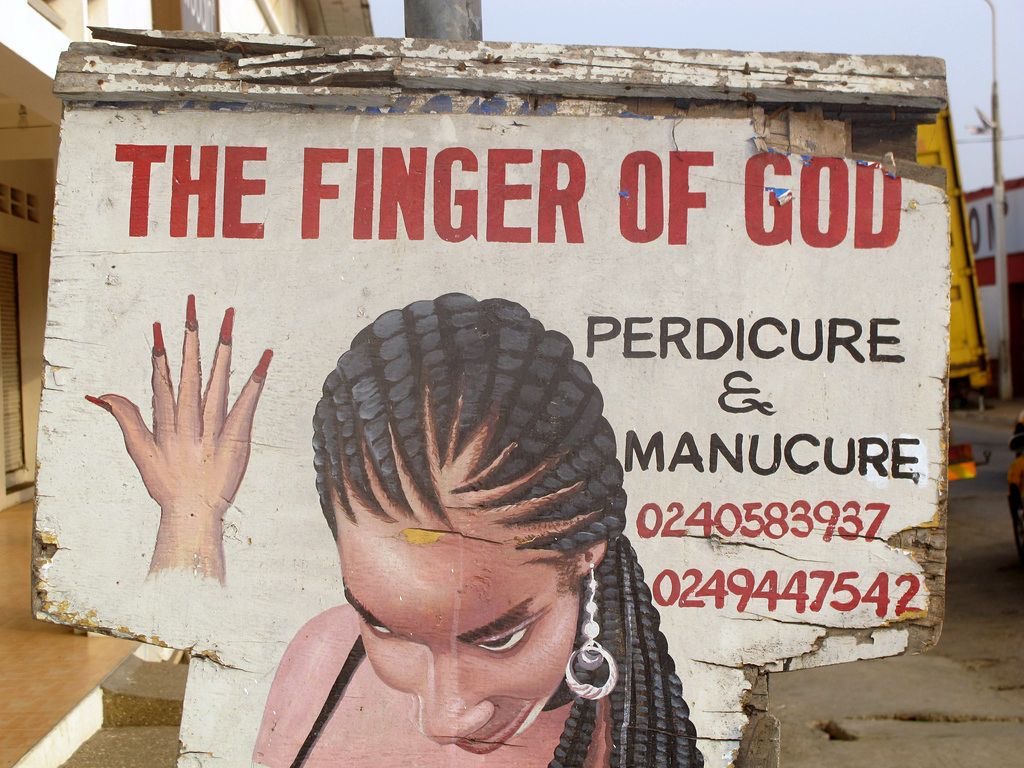
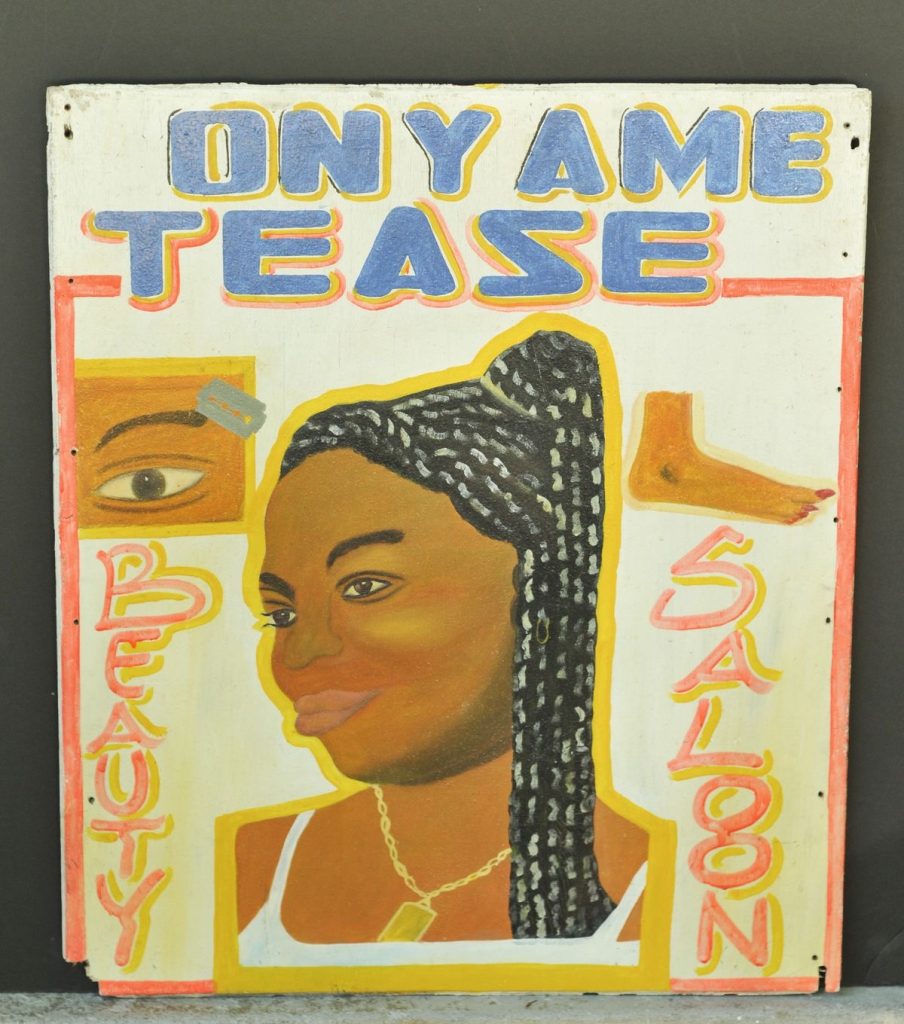
The salon and barbershop names lean heavily on faith. GOD IS KING HAIR CUT. THE FINGER OF GOD. GLORY BE TO GOD BEAUTY SALON. A name like that is a declaration painted where anyone walking past has to read it, repeated every day the business stays open. ONYAME TEASE BEAUTY SALON (God is alive) carries that further than most, a full statement of faith sitting directly above where the hair actually gets done.
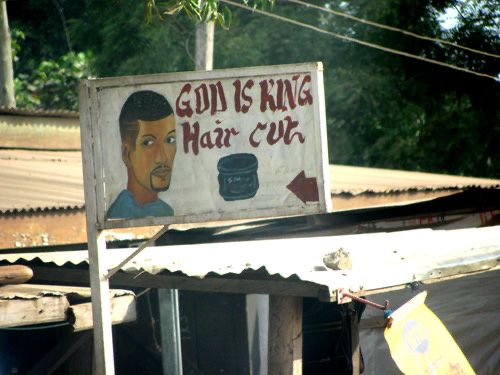
The haircut names are claiming something different, aimed at the customer rather than the business. Oboye Tyson Cut, America Top Zip Cut, Forex Bureau, Back Bow, none of these describe what the hair will actually look like the way fade or taper would. Oboye isn’t even part of the style’s name so much as it is how you’d address the barber himself or how the barber would address you, closer to bro or chale than a formal title, so the full phrase is less a product name than something closer to a friend offering you what a boxer or an airline or a currency exchange already carries. Choosing the Boeing 707 means claiming, for one afternoon, whatever that borrowed name is supposed to mean.
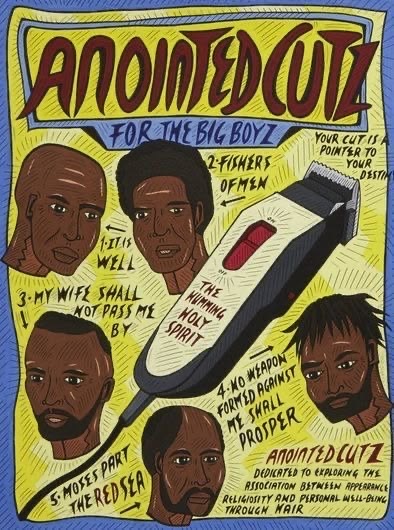
Not every haircut borrows its status from a boxer or an airline. ANOINTED CUTZ: FOR THE BIG BOYZ, names its five house cuts after scripture instead. It Is Well. Fishers Of Men. My Wife Shall Not Pass Me By. No Weapon Formed Against Me Shall Prosper. Moses Part The Red Sea. Even the clippers get a name, THE HUMMING HOLY SPIRIT, so the tool doing the cutting is folded into the same declaration as the cut itself. YOUR CUT IS A POINTER TO YOUR DESTINY, the board says outright, which is the plainest possible version of what every named haircut on this board has been claiming all along, usually without saying so directly. The shop’s own printed description goes further still: dedicated to exploring the association between religiosity and personal well-being through hair. Somebody had already written what a name like this is supposed to do for the person wearing it onto the wall, before there was any essay to ask it.
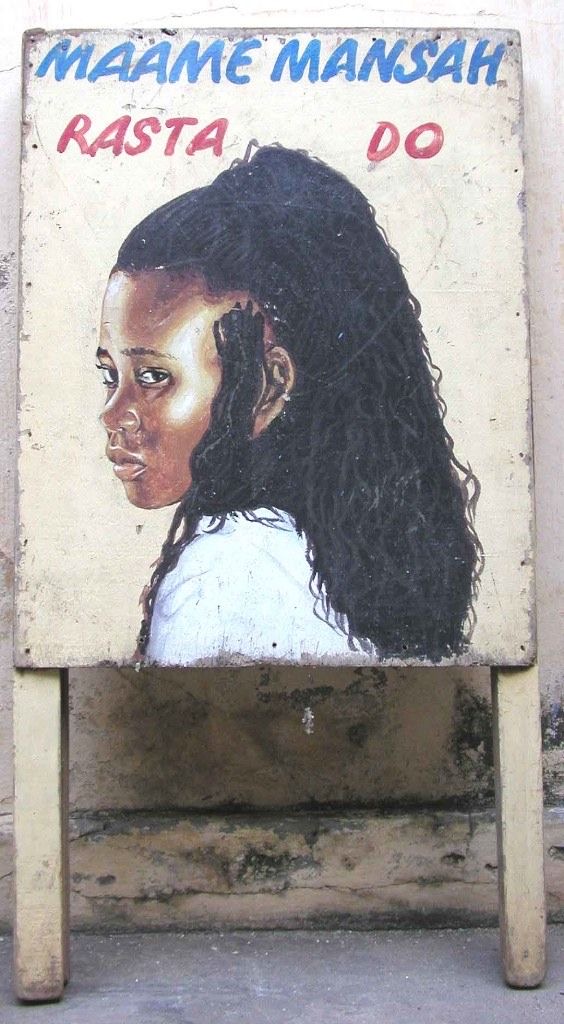
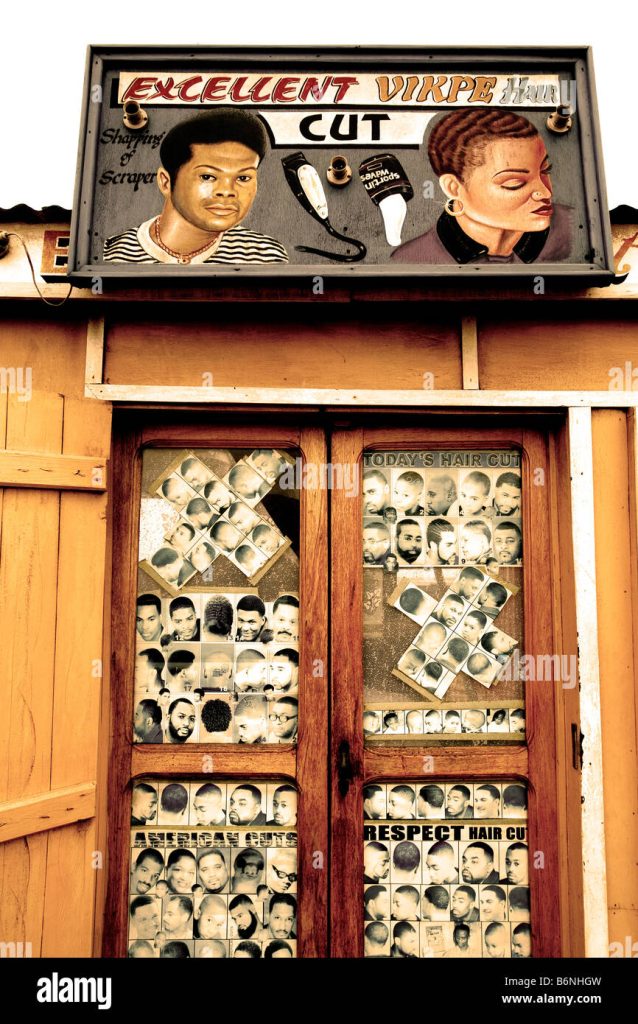
Gender splits the visual language, but not evenly. Some barbershop boards read like catalogues, name after name stacked in a menu. Some salon boards slow all the way down to one face, close and unhurried. Others do the opposite, one board holds close to ten different heads at once, each hairstyle shown from behind, a whole range on display rather than a single mood. And at least one barbershop door barely bothers with lettering at all, covered in taped-up photographs standing in for a menu that doesn’t need the words hair cut written anywhere on it. The image has become the type there. Nobody has to read that door to know what’s sold behind it.
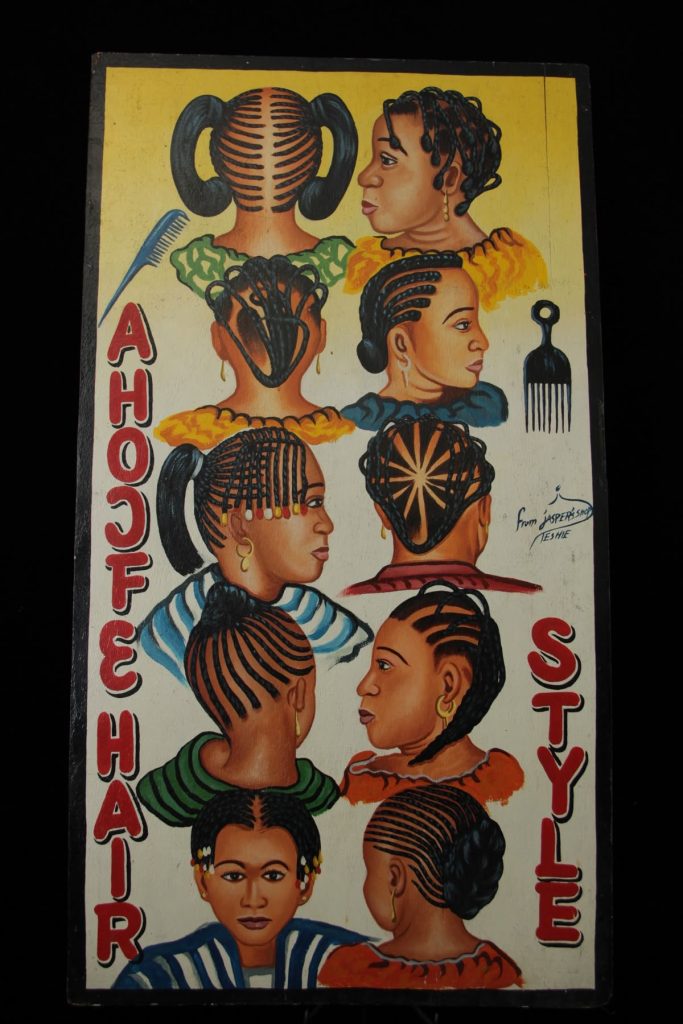
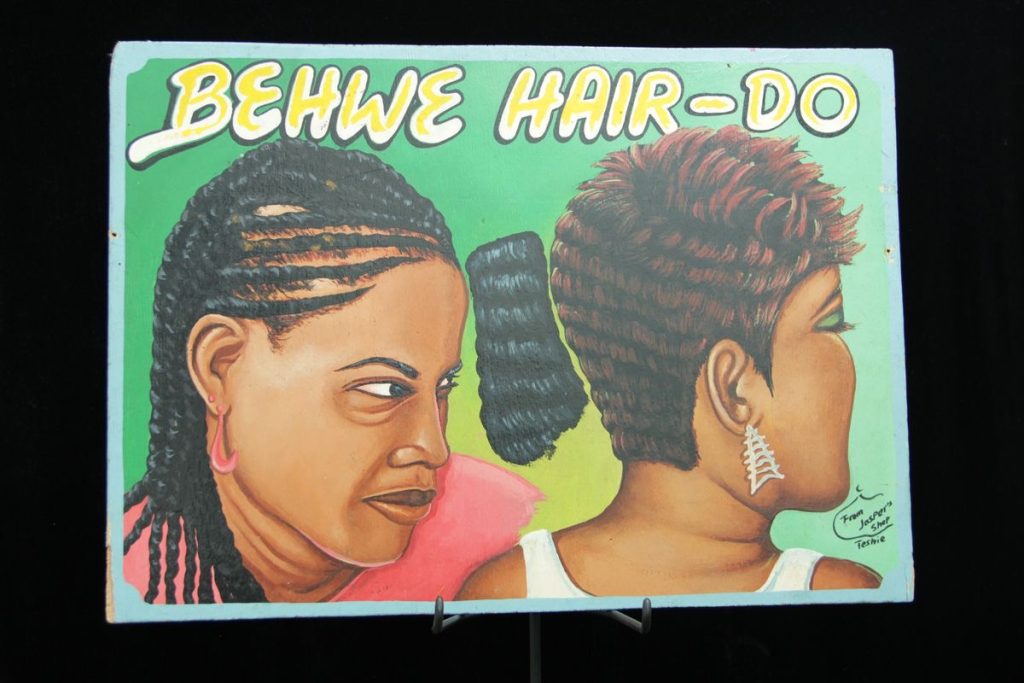
AHOƆFƐ HAIR STYLE and BƐHWƐ HAIR-DO carry the same signature in the corner, Jasper’s Shop, Teshie. A good sign painter tends to work one neighbourhood repeatedly rather than travelling far for each commission, so a signature turning up twice nearby isn’t unusual, it’s closer to how the trade actually works. But it does mean a particular hand, a specific way of drawing a profile or shading a braid, can belong recognisably to one painter across several storefronts on the same road, whether or not anyone passing by ever learns his name.
Even the misspellings repeat themselves the way the haircut names do. saloon for salon, on three different boards, by what looks like three different hands. perdicure for pedicure, manucure for manicure. Nobody corrected any of them, and to be honest, nobody needed to. The word did its job either way, which says that these boards are optimised for recognition and not correctness.
All of this is disappearing anyway. 3D signs, vinyl, and printed photographs are replacing the painted board across Accra, and hand-painted hair signage seems to be going out of style faster than most. It’s not a cost-saving trade: a 3D sign for a barbering shop or hair salon is not obviously cheaper than a board a local painter charges to hand-paint, and may well cost more. It’s closer to the shift from a flip phone to a smartphone: not that the old one stopped working, but that it stopped being what people expect to see.
What a city learns to associate with beauty will survive that shift just fine. A photograph teaches the eye a standard exactly as well as a painted board does, cornrows and fades and braids recognisable on sight either way. The naming instinct itself survives too. Salons will keep calling themselves God Is King. Barbers will keep naming cuts after boxers, airlines, scripture, – whatever the register, printed or painted. What doesn’t survive is this exact record of it, Boeing 707 in one painter’s hand, a name spelled the particular way this hand spelled it, five scripture cuts catalogued together on a single board that won’t get repainted once it’s gone. The convention outlives the artifact. It just won’t look like this again.
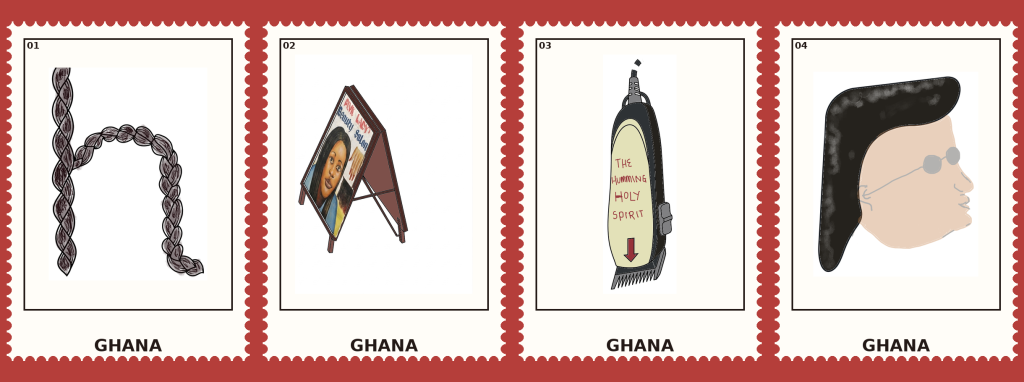
This is Textual Claims: typography used to investigate public life. The illustration below is my interpretation of the word HAIR, using depth and dimension so the text itself becomes the image.