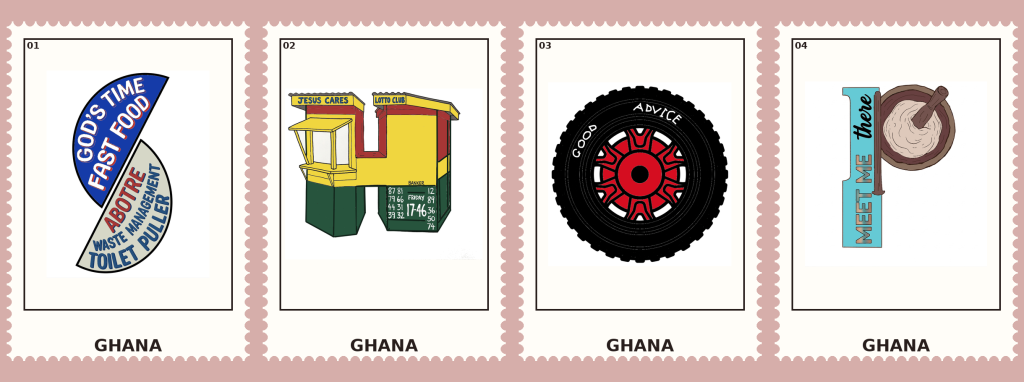
A hardware store in Accra is called GOOD ADVICE. Not Good Advice Hardware, not Good Advice Tools and Fittings, just GOOD ADVICE, painted across a red board with a phone number and nothing else, hammers and tape measures and padlocks hanging beneath it, the name never mentioning what’s actually for sale. What they learn is that the person running it wants to be trusted before they’ve bought anything at all.

That’s the real work happening across almost all of this text, and it isn’t Enterprise or LTD doing it, most of these names never reach for that word. GOD’S TIME FAST FOOD, ESE WENI CHOP BAR, ADOM COLD STORE, these mostly just sit next to what kind of shop this is, provision store, chop bar, cold store, the category doing the identifying and the name doing something else entirely.


Even the bluntest-looking sign in the set turns out not to be so blunt. ABOTRƐ WASTE MANAGEMENT TOILET PULLER reads at first like pure function, a cartoon truck and a man with a hose doing the same job the words do. But abotrɛ means patience, and patience is exactly what this trade demands, of the men doing it and of everyone pretending not to notice them doing it. The virtue name is there, it’s just standing next to the job.
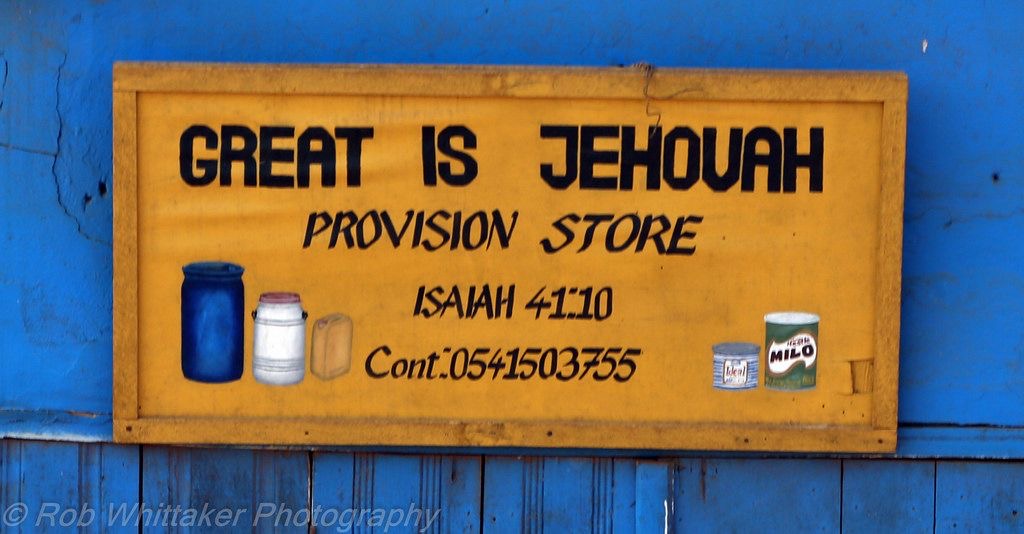
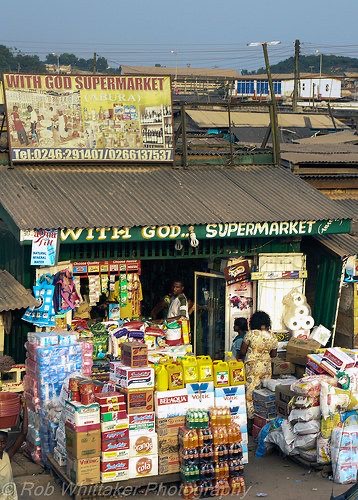
What the name does, most often, is claim a future the shop hasn’t earned yet. GREAT IS JEHOVAH sits above PROVISION STORE in black on gold, a scripture reference and a phone number underneath it, Isaiah 41:10: fear not, for I am with you. That’s not a slogan borrowed loosely, someone chose that verse specifically, the way a parent chooses a name for a child expecting it to mean something for the rest of that child’s life. WITH GOD SUPERMARKET does the same thing at a different scale, God folded directly into the business category itself, not beside the name but inside it. This is naming as a kind of outdooring, the ceremony where a child’s name is spoken aloud in public for the first time, deliberate, heavy, meant to call something into being rather than just label what’s already there. A shop sign does the same work in text instead of speech, and because it’s written rather than spoken, it keeps making that declaration every single day, long after the ceremony would have ended.
Naming reaches for individual credit too, not just craft or faith. GOD’S TIME FAST FOOD carries a second line underneath it in smaller yellow text, Sister Alice Hands, naming the specific person whose cooking this actually is. The dish is generic, (fast food, banku) but the hands making it are not, and the sign insists on saying so.
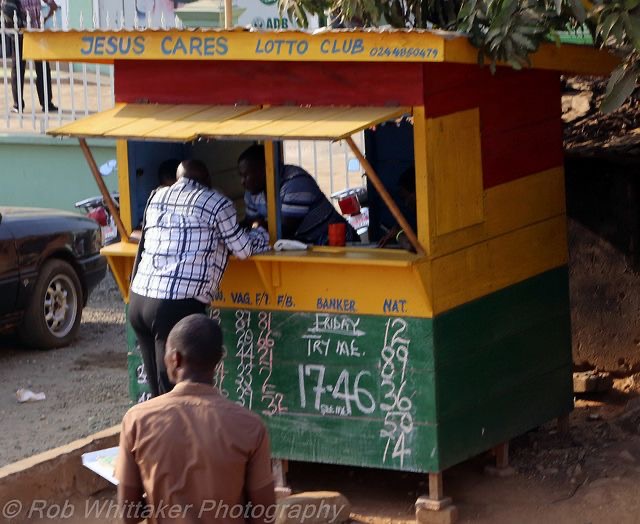
Not everything here is asking to be believed in. JESUS CARES LOTTO CLUB puts a name that means comfort and providence directly above a betting board, odds chalked up in the same breath as the blessing. And it’s not hypocrisy so much as it is honesty about what people actually need faith to do for them; to sit beside risk rather than replace it.
And then there’s the one that refuses the whole register entirely: a fast food shack with banku, jollof and yam painted plainly across its face, and along the roofline above it, in a completely different hand, THE EVIL THAT MEN DO LIVES AFTER THEM. Nothing about that sentence is selling jollof. It’s not a name and it’s not a blessing, it’s a proverb about consequence sitting on top of a lunch counter, and the mismatch is the whole point, this business has more on its mind than food, or the sign painter did, and either way nobody stopped it from going up.

YƐNE WO SERE KWA, translates closer to we are only laughing with you, a phrase that draws its own boundary in advance: this friendliness is surface-level, don’t mistake it for a bond. It’s an unusual thing for a typical Ghanaian business to put in writing. Commercial text usually works hard to reach for intimacy, blessings and personal touches, this one does the opposite, disclaiming the relationship before a customer’s even had the chance to assume one.


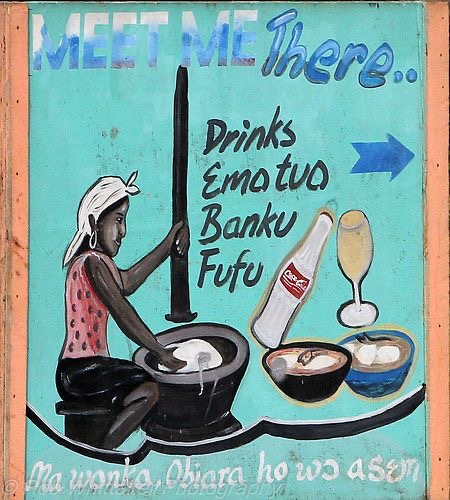
The typography is doing more than holding the words up. MEET ME THERE ends on a proverb in Twi along the bottom edge, casual invitation up top, inherited wisdom underneath, two different registers sharing one board without any visual separation between them at all.
And the scale of ambition rarely matches the scale of the building. A single room with a corrugated roof and one window can carry a name like GOD’S TIME or GOOD ADVICE just as confidently as an actual supermarket does, because the sign was never really describing the room. It was describing what the room was supposed to become. The typography arrives fully formed before the success does, sometimes years before, sometimes never, and either way the sign keeps making its claim every day regardless of what’s actually happening inside.
A name spoken over a child asks God to make it true. A name painted over a shop asks the customer to believe it already is.
What does a name promise before the business has done anything to earn it? Trust, mostly, and permanence, and a future tense dressed up as a present one. GREAT IS JEHOVAH standing over a shelf of tinned milk the same way it would stand over a cathedral, because the size of the claim was never going to wait for the size of the shop to catch up.
This is Textual Claims: typography used to investigate public life. The illustration below is my interpretation of the word SHOP, using depth and dimension so the text itself becomes the image.